
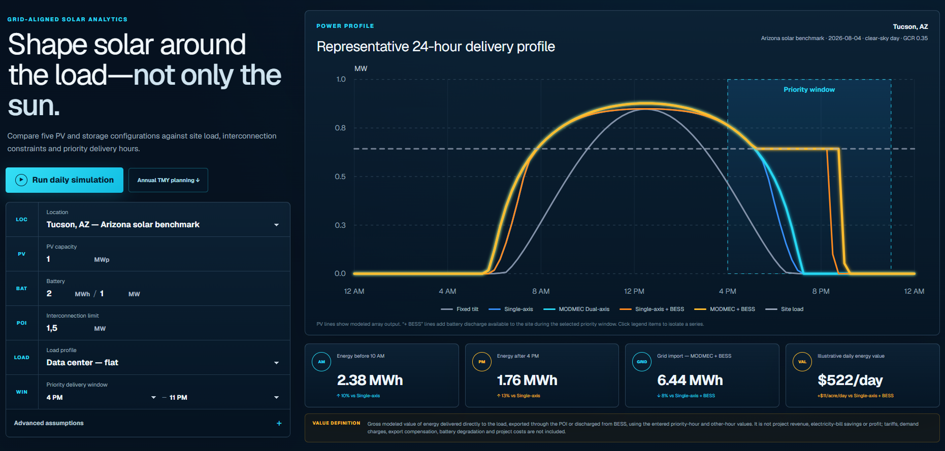
Solar and storage are often described through a simple sequence: PV produces during the day, the battery stores the energy, and the battery delivers it later. The more useful question is how much temporal work remains for BESS after the PV profile has served everything it can serve directly.
Battery work is not one universal metric. It can mean MWh charged and discharged, peak charging or discharging power, state of charge reserved for a priority window, the energy capacity needed to meet a delivery obligation, cycling over time, or grid energy needed to supplement PV charging.
A PV profile that serves more load directly or remains productive closer to a critical period may reduce one or more of those requirements. It may also have little effect. The outcome depends on load, location, weather, interconnection, battery design and the dispatch objective.
Storage is an hourly resource.
California operating data illustrate the timing problem. In its 2024 battery report, CAISO found that charging represented approximately 14.7% of balancing-area load during hours ending 10 through 13. During hours 17 through 21, batteries supplied about 8.6% of balancing-area energy. Most large operating systems had a maximum duration of four hours.[1]
Substantial quantities of energy are therefore moved from solar-rich hours into the late afternoon and evening. That movement is valuable, but it remains subject to power, energy and conversion limits. CAISO also notes that short discharge duration, modeling limitations and bidding behavior can prevent batteries from being fully charged and available during peak net-load periods.
Dispatch quality matters as much as the hardware.
Lawrence Berkeley National Laboratory's May 2026 study modeled hourly dispatch for 280 operating PV+storage projects—approximately 95% of the U.S. operating fleet in 2024—across seven ISO/RTOs and 19 additional balancing authorities.[2][3]
With perfect price and generation foresight, optimized dispatch increased the modeled national generation-weighted wholesale value of solar from $29/MWh to $75/MWh in 2024. Empirical operations realized $39/MWh, or 62% of the modeled optimized value. Berkeley Lab identified barriers including simple rule-based dispatch, imperfect forecasting, limited market participation, contractual constraints and restrictions affecting grid charging.[2][3]
These figures describe wholesale-market projects, not behind-the-meter data centers, and should not be transferred into a site-level business case. Their relevance is methodological: operating constraints and dispatch can create a large gap between modeled potential and realized performance.
Three ways a PV profile may reduce battery work.
1. More direct-to-load delivery
Every MWh of PV that coincides with site load can avoid routing that energy through storage. This can reduce charging and discharging throughput and avoid part of the associated conversion loss.
For a flat or nearly flat load, extending useful PV production into the morning and late-afternoon shoulder hours can matter even when the annual-generation difference is modest. The relevant comparison is the quantity delivered directly to load under identical system boundaries.
2. A stronger state of charge before the priority window
If a project must support a defined period—such as 4–9 PM or 4–11 PM—the state of charge at the beginning of that period is a key planning variable. A PV profile that continues charging later may reduce grid charging or preserve more stored energy for that window, depending on load and control strategy.
This does not guarantee a smaller battery. A long delivery window may still require the same MWh rating. It changes the question from how much solar was produced to what battery state was available when the obligation began.
3. Lower required power or energy for the same service
If PV continues serving part of the load while the battery is discharging, instantaneous demand on BESS may be lower. In some cases that could reduce the required MW rating, MWh rating, or both.
This is a design hypothesis, not a general rule. It must be tested by progressively reducing battery power and energy while holding the service requirement constant. Both systems must be asked to meet the same load, priority window, grid-import ceiling and reliability criteria.
When a broader PV profile may not help.
Better alignment does not automatically create a smaller or less active battery. The benefit may be limited when:
- the priority period begins after practical PV production has ended;
- all PV is consumed immediately under every configuration;
- the battery is sized for backup duration rather than daily shifting;
- unrestricted utility charging is economically preferable;
- POI or inverter limits prevent additional energy from reaching load or BESS;
- seasonal worst-case conditions determine the design;
- firm-capacity or resilience rules apply independently of expected solar output; or
- the additional tracking and control cost exceeds avoided storage or grid cost.
An annual production uplift alone is therefore insufficient evidence for a battery-related performance or cost claim.
What should be measured.
An early-stage hourly comparison should report at least:
- annual load served on site and PV delivered directly to load;
- PV energy before 10 AM and after 4 PM;
- energy charged to BESS before the priority window;
- maximum utility import and required interconnection capacity;
- curtailed or unusable PV energy;
- battery charging and discharging throughput; and
- the minimum battery MW and MWh that can meet the defined service.
Equivalent full cycles, depth of discharge, temperature and calendar aging belong in a detailed battery-life assessment. Throughput alone is not a warranty-life prediction. NREL's storage modeling work distinguishes calendar and cycling degradation and treats efficiency and degradation as technology- and use-case-dependent inputs.[4]
Hourly solar modeling also carries uncertainty. PVWatts V8 supports hourly output and fixed, one-axis, one-axis with backtracking and two-axis configurations, but the documentation cautions that simplified performance estimates contain assumptions and do not replace site-specific engineering.[5]
The MODMEC hypothesis.
MODMEC's working hypothesis is that a row-based dual-axis architecture coordinated with Smart Watts controls can broaden the useful PV delivery profile and improve its interaction with site load, BESS and an interconnection limit.
Annual MWh and a representative chart do not prove that hypothesis. It should be tested against fixed-tilt and single-axis alternatives with identical assumptions for DC capacity, weather and losses, load, BESS, POI, dispatch objective, delivery window and land use.
The useful result is not “dual-axis wins.” The useful result is a boundary: the locations, load shapes and constraints under which changing the PV profile produces a measurable reduction in battery throughput, grid import or required storage—and the conditions under which it does not.