
The timing and shape of solar generation determine how often a connection is saturated, how much energy can serve the load directly, how effectively a battery can be charged and how much capacity must still be supplied by the utility.
Annual MWh remain important. But once interconnection becomes scarce, they are no longer enough.
Interconnection is becoming a defining project constraint.
At the end of 2025, approximately 8,200 projects representing 1,312 GW of generation and 749 GW of storage were actively seeking U.S. grid interconnection. For projects completed in 2025, the median time from interconnection request to commercial operation exceeded five years. Of the capacity submitted to queues between 2000 and 2020, only 13% had reached commercial operation by the end of 2025.[1]
Berkeley Lab's analysis covers all seven ISO/RTO regions and 50 non-ISO utilities—approximately 98% of installed U.S. generation capacity.[1] These figures show how valuable access to the grid has become. They do not, however, mean that every project with an interconnection constraint faces the same problem.
The queue and the operating limit are different constraints.
The interconnection process determines whether a project can connect, what studies and upgrades are required and what the project may need to pay. The point-of-interconnection limit determines how much power the site can import or export at a given moment.
A project can obtain an interconnection agreement and still operate behind a restrictive POI. Conversely, a project with an attractive generation profile must still complete the applicable utility and grid-operator process.
A constrained POI turns generation shape into project economics.
Consider two PV systems with the same annual generation. The first concentrates more production around midday. The second spreads more production into the morning and late afternoon. If both operate behind the same POI, their annual MWh may have different practical value.
When generation exceeds what the connection, load or battery can absorb, the excess must be stored, curtailed or clipped, redirected to another permitted use, or lost as a project opportunity. A broader production profile may use the available connection over more hours, serve more load directly or charge storage closer to the required delivery window.
That is a system-design hypothesis, not a universal result. The value depends on load shape, tariff, market prices, storage configuration, export permissions and the physical performance and cost of the PV system.
Clipping, POI constraints and grid curtailment are not the same.
Clipping normally occurs when available DC production exceeds the conversion capability of the inverter or another plant-level limit. A POI constraint limits the amount of power that can move through the project's grid connection. Grid curtailment is typically caused by system conditions such as transmission congestion, oversupply or reliability instructions.
CAISO curtailed 3.4 million MWh of utility-scale wind and solar generation in 2024, 29% more than in 2023. Solar represented 93% of that curtailed energy.[2]
This is system-level evidence of a growing mismatch between when electricity is available and when or where the grid can accept it. It is not evidence that a particular tracker or project configuration would have avoided that curtailment. Project-level performance must be studied separately.
Storage changes the boundary—but does not eliminate it.
A battery can absorb solar energy that would otherwise exceed the load or export limit and deliver it later. Its ability to do so depends on charging and discharging power, usable energy capacity, state of charge, round-trip efficiency, degradation and cycling limits, charging permissions and the selected dispatch objective.
FERC Order No. 2023 requires transmission providers to allow multiple generating facilities to share a site behind one point of interconnection and to reflect proposed storage charging behavior in interconnection studies.[3]
That does not mean that adding a battery automatically solves an interconnection problem. It means that the charging strategy and operating configuration must be modeled explicitly.
DOE's Transmission Interconnection Roadmap sets a 2030 target of less than 12 months from interconnection request to agreement for completed projects and a target for substantially lower variation in assigned interconnection costs.[4]These are national targets—not outcomes that have already been achieved.
What should projects measure?
Before selecting a PV and storage architecture, a constrained project should evaluate more than annual production:
- Maximum import and export at the POI.
- Number of hours the connection reaches its limit.
- Energy that cannot be exported or consumed directly.
- Solar energy delivered directly to the load.
- Energy charged into the battery before the required delivery window.
- Battery state of charge at the start of the priority period.
- Battery power, duration and annual throughput.
- Remaining utility import during constrained or high-value hours.
- Time-weighted value of delivered energy.
- Project economics after equipment, land, losses and operating costs.
The correct design is not necessarily the system producing the most annual MWh. It is the configuration that produces the most useful energy at an acceptable total project cost and risk.
The MODMEC hypothesis.
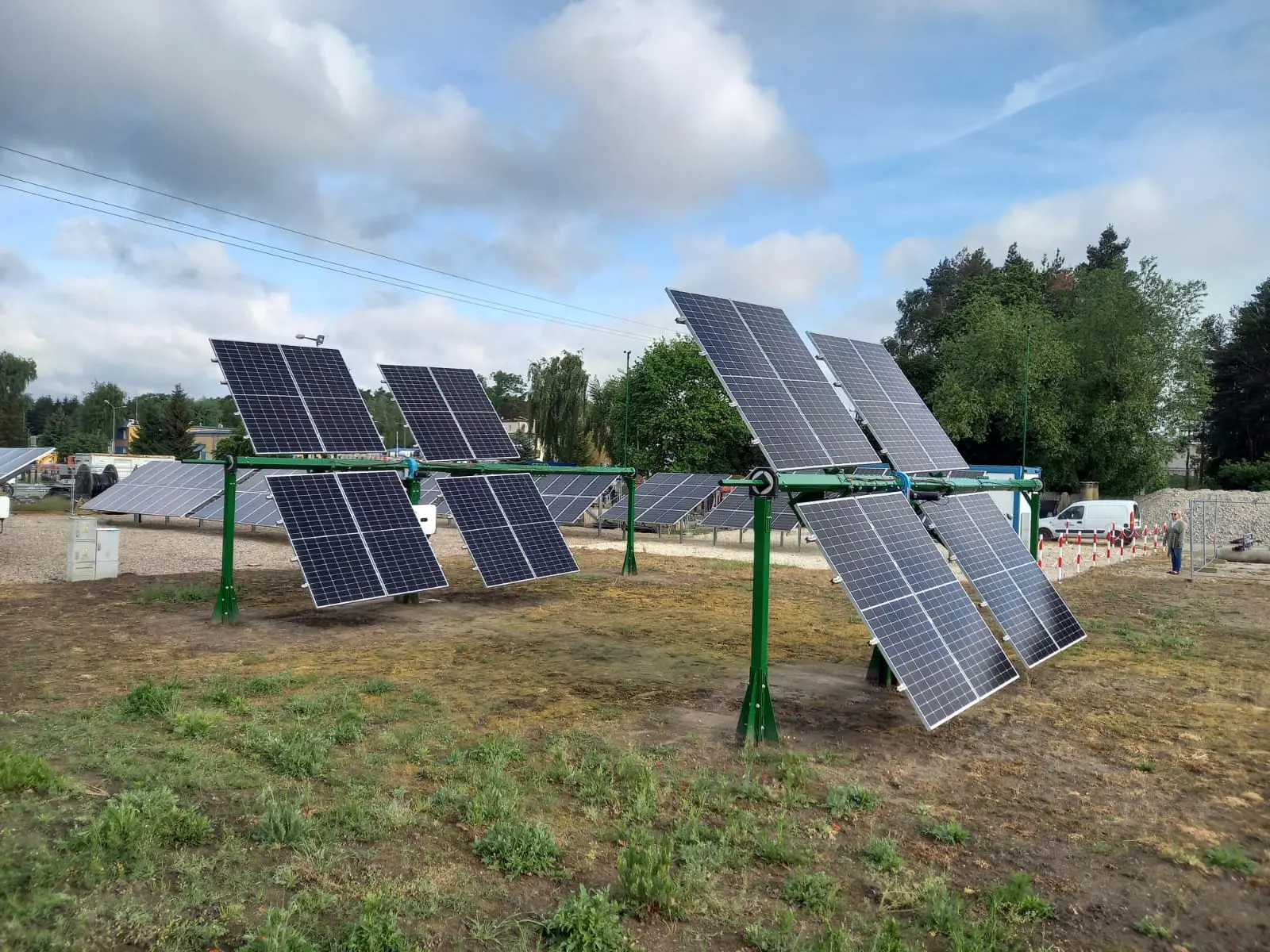
MODMEC is evaluating whether a row-based dual-axis architecture combined with Smart Watts controls can create a broader and more controllable solar profile.
The planning hypothesis is that such a profile may:
- increase direct delivery to a continuous load;
- use a constrained POI across more hours;
- charge BESS closer to an evening priority window; and
- reduce the residual work left for storage and the utility.
These outcomes are not established by annual-yield comparisons. They must be tested using matched weather, module capacity, load, POI, GCR, storage and dispatch assumptions—and ultimately validated with field data.