
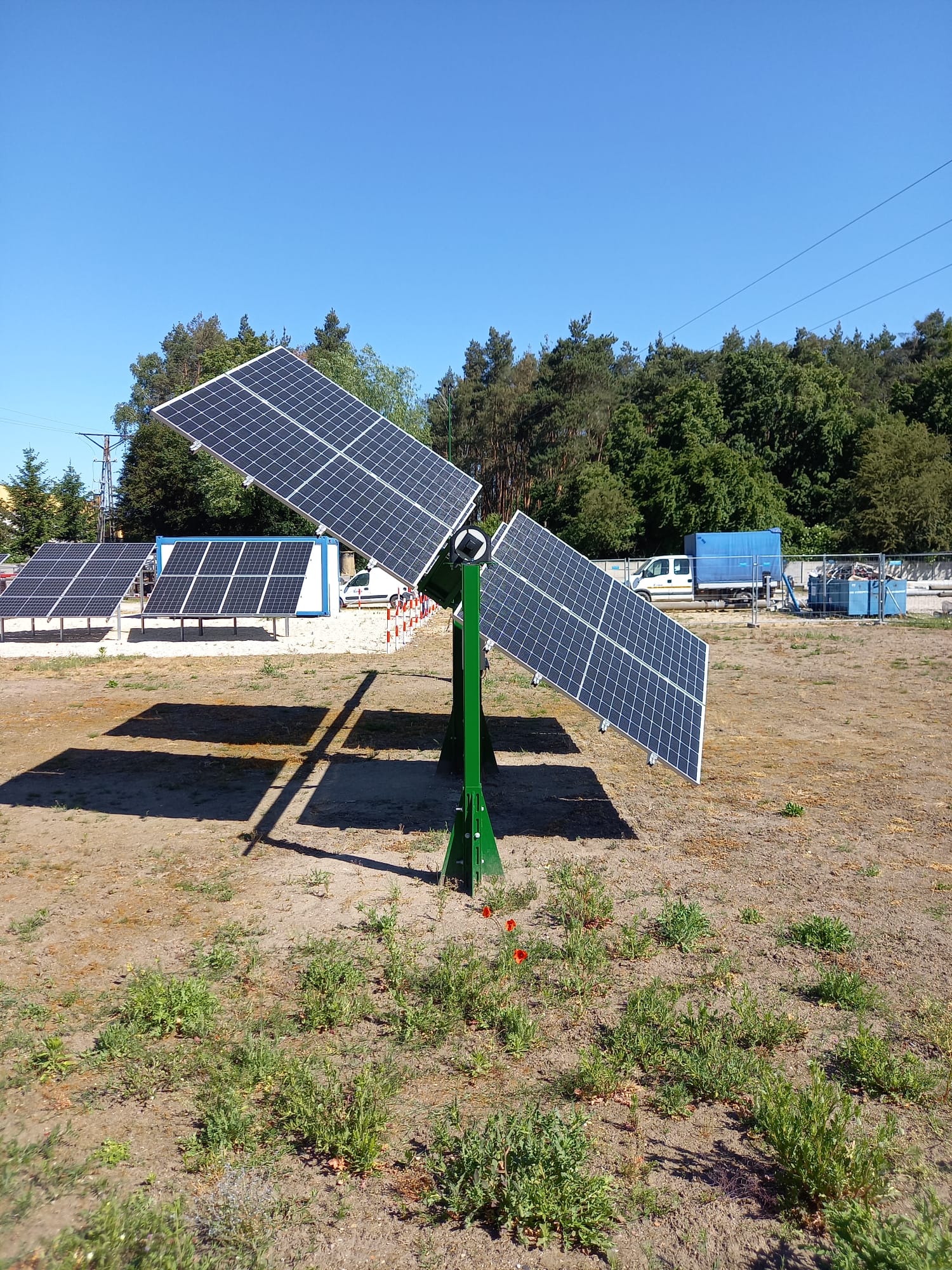
In a solar-plus-storage project, midday is not a problem to design away. It is often the moment when photovoltaic generation serves the active load and charges the battery for the hours that follow.
The stronger question is what happens next. As the sun moves west and demand approaches a priority window, can the PV system remain useful long enough to protect stored energy, delay battery discharge and reduce the project's dependence on the grid?
That outcome depends on the complete system: collector geometry, tracker control, module and inverter limits, load shape, battery power and energy, state-of-charge strategy, interconnection constraints and local weather.
This is not midday versus late afternoon.
Midday production remains essential. It can supply a large share of the site's immediate demand, provide the strongest charging opportunity for the battery and make productive use of the solar resource before the evening ramp.
MODMEC is not intended to flatten or sacrifice that peak. The design objective is maximum feasible production around solar noon within the limits imposed by irradiance, module and inverter ratings, temperature, shading and the point of interconnection. The question is whether the same architecture can preserve that strong noon output while remaining useful for longer in the afternoon.
California's grid is already telling time.
California ISO data show the daily sequence clearly. Batteries charge during high-solar hours and discharge later, when solar output falls and net load rises. In 2024, battery charging represented about 14.7% of CAISO balancing-area load from hour-ending 10 through 13. During hours 17 through 21, batteries supplied an average of about 8.6% of balancing- area energy.[2]
The scale continued to grow. Across the Western Energy Imbalance Market, total downward dispatch of wind and solar increased by about 22% in 2025. Economic bids accounted for about 4,780 GWh of curtailment. At the same time, average battery discharge peaked at about 9,100 MW in the evening, compared with about 5,700 MW in 2024.[1]
These figures do not prove the value of one tracker architecture. They show why time must be part of the comparison: solar is strongest around midday, batteries absorb part of that energy, and the system's need shifts rapidly toward the evening.[4][5]
A longer solar afternoon can protect stored energy.
Consider a site with a relatively flat load and a battery reserved for a late-day priority window. Around noon, PV can serve the load and use the remaining power to charge the battery. Later in the day, continued PV production can keep serving part of the load—or top up the battery when the control strategy allows it.
The potential system effects are practical:
- more demand served directly by PV before the battery is needed;
- a higher state of charge at the start of the priority window;
- later or more gradual battery discharge;
- less grid import during selected late-afternoon and evening hours; and
- more operating flexibility around a constrained point of interconnection.
None of these benefits is automatic. A broader PV profile does not by itself guarantee a smaller battery, fewer cycles or lower cost. Those results depend on dispatch logic, efficiencies, degradation limits, tariffs and project-specific operating objectives.[6]
The handoff matters as much as the peak.
A useful solar-plus-storage profile is a sequence rather than a single production number:
Improving the handoff can mean strong midday charging, continued direct solar supply in the afternoon, a later start to material battery discharge, more stored energy available for the evening and a smoother transition at the point of interconnection.
Annual MWh remain important, but they cannot describe that sequence. The analysis needs hourly—or finer—generation, load, battery and POI data.
Late-afternoon solar is not firm evening capacity.
Solar production later in the day is still weather-dependent and seasonal. It does not guarantee output after sunset, replace storage, eliminate dispatchable resources or remove the need for a reliable grid connection.
The narrower and more defensible claim is this: if a PV architecture preserves more useful production as the sun moves west, it may improve the interaction among direct load, battery state of charge, discharge timing and grid import. That improvement must be measured for the actual site and operating window.
Architecture changes availability.
Fixed-tilt, single-axis and dual-axis systems can deliver different hourly profiles even when they use the same module technology and DC nameplate capacity. Orientation, movement range, control logic, row spacing, self-shading and backtracking all influence when the resource is available.[3]
A generic “two-axis” label is therefore not enough. A credible comparison must represent the actual collector dimensions, pivot geometry, movement limits, spacing, terrain, shading relationships, inverter clipping and control strategy.
It would also be misleading to reduce MODMEC's noon output artificially just to create a wider-looking curve. The relevant test is simultaneous performance: maximum feasible noon production plus useful energy before and after the peak.
The MODMEC hypothesis.
MODMEC is developing a low-profile, row-based dual-axis architecture with independently controlled collectors and the Smart Watts™ control layer. Its hypothesis is not late-afternoon energy instead of midday energy.
The hypothesis is that one system can combine:
- maximum feasible production around solar noon;
- direct supply to an active site load;
- a strong midday charging opportunity for BESS;
- useful morning and late-afternoon generation; and
- coordinated operation around load, battery state and POI limits.
In that operating sequence, noon production does the heavy charging. A broader afternoon profile continues serving the load, helps preserve battery state of charge and can delay the point at which the battery—or the utility—must take over.
TESTABLE SCENARIO
Measure the charge—and the handoff.
Compare fixed tilt, single-axis and MODMEC with the same modules, DC capacity, weather, loss assumptions and gross site boundary.
- Location
- Los Angeles, California
- PV capacity
- 1.0 MWp
- Load
- Data center — flat, 0.65 MW maximum
- POI / utility
- 0.80 MW
- Battery
- 1.0 MWh / 0.5 MW
- Priority window
- 16:00–21:00
- GCR
- 0.35
- Comparison
- Fixed tilt · single-axis · MODMEC
Record the full sequence
- annual generation and generation from 10:00–14:00;
- generation after 16:00 and direct-to-load energy;
- PV energy routed to the battery and maximum charging power;
- battery state of charge at 16:00 and first material discharge;
- battery throughput, maximum grid import and import from 16:00–21:00;
- curtailment and time-weighted energy value.
Run the PV-only case first so the raw generation profiles remain visible. Then add the battery and compare priority windows of 15:00–19:00, 16:00–21:00 and 17:00–21:00. Repeat the scenario in Tucson with site-specific weather to test how resource and solar geometry change the result.
Open the MODMEC simulatorThe decision rule.
Do not judge the systems only by the height of the midday peak or by annual MWh. Ask how much load is served directly, how strongly the battery charges, what its state of charge is when the priority window begins, when discharge starts, how much energy passes through the battery and how much grid import remains.
The best profile may be the one that works hardest at noon and remains useful for longer afterward.
That is a stronger definition of solar value than another isolated midday megawatt.